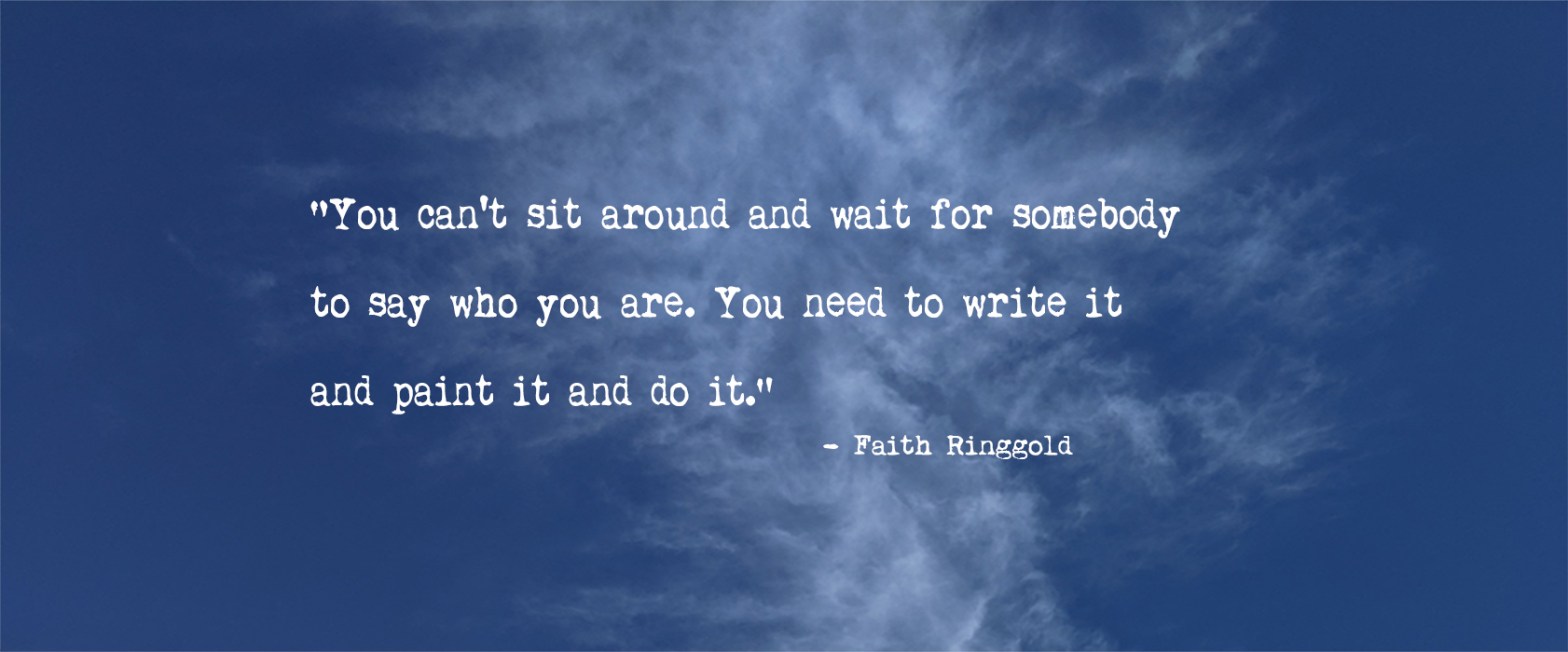
Many of you may not know that I have a deep love of art (and architectural) history. My passion for art grew exponentially when I took a course from the late Thalia Gouma-Peterson, professor of art history at The College of Wooster, in 1991.
The class was Women Artists 1940-Present, and wouldn’t you know that Thalia had pieces from her personal collection that she brought in to class and passed around: I recall caressing the curve of a sculpture from Elizabeth Catlett, marveling at the kinetic energy of a small Louise Bourgeois sculpture, tracing the lines of a Miriam Shapiro painting, and falling deeply in love with everything Louise Nevelson created. Those classes flew by in what felt like an instant — Thalia had a remarkable way of teaching that drew you in, captivating your imagination and not letting go until you walked back out into the weak Ohio sunlight, blinking, certain you’d just been on another planet entirely.
During a meeting with Thalia wherein we discussed the possibility of my helping her (as a teaching assistant), she called me a feminist. “Um, I’m not a feminist,” I replied rather meekly. Thalia squared her strong shoulders, sat up straighter and looked me in the eye. Burned through.
“Of course you are a feminist,” she said, her Greek accent thick with certainty. She laughed. “Deny it all you want, my dear. But you are a feminist.”
She changed my life that day.
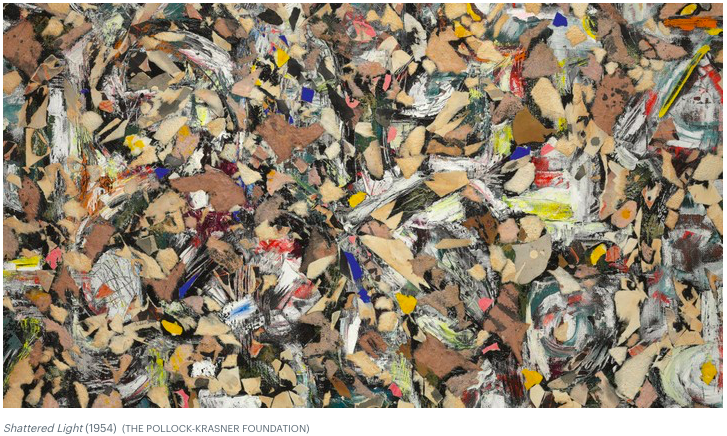
“Women Artists 1940-Present” also introduced me to the work of artist Lee Krasner, whose name was often synonymous with her husband, Jackson Pollack. A remarkable artist in her own right, Krasner’s work was frequently overshadowed by Pollack’s fame, but her contributions to modern art cannot be underestimated. Exploring the outer reaches of abstract expressionism, Krasner’s work had energy to spare, and I often found myself getting lost in her paintings. Unfortunately, her intense self-criticism and a near-obsessive tendency to revise and revise her work led her to burn or destroy many paintings and collages. Lucky for us she didn’t reduce them all to ashes.
This one, ‘Shattered Light’ (1954), is a favorite.
Which leads me to today’s #backpocketpost, a poem, “Regards for the inner light (L.K.).”
(In the 40s-50s, Krasner often left work unsigned, or used the genderless initials “L.K.” Typically in the 1940s and 1950s, Krasner also would not sign works at all, sign with the genderless initials “L.K.”. She also incorporated her signature into the painting itself, blending it until almost unrecognizable, as she did not want to draw attention to the fact that she was a woman or the wife of a famous painter.)
Lately I’ve been thinking of what Hans Hoffman, one of Krasner’s early teachers, said to her in 1937: “This is so good, you would not know it was done by a woman.”
(2020 reframe: This is so good, you know it was done by a woman.)
The poem that follows grew out of that comment.
Regards for the inner voice (L.K.)
Linseed-scented skin, bitten nails
fine wrists, hollows in places
few could reach,
she was not the climbing
or falling through
Brooklyn-born, Bessarabia-bred
she was the rising early
the first spark
the being pulled into
her forms not a likeness
but a flight in
And when she opened her doors
no language save collage
rushed out
cubist musings
on economies of ego
scissors at the ready
and half-day silences
thick with smoke after smoke
bread, then bourbon, the pigments
spread, the pendulum swings
work so good you would not know
it was done by a woman.
Contemplating
deliberate destruction
of what sits before her,
she pulls on a black coat
walks the creek bank
din of crickets and
inner critics rising and falling
like a dirge. Surrounding her,
pushing at her, 50s America
perfect and pure
so many pretty pictures
each one lacking a pulse.
Scenes but not events
like history without ruins
or vast museums built
to house the dull.
She returns to the studio
stokes the woodstove
and rips the canvas
from its frame. There is
no time like the past.
Let it burn.
Featured artist: The Still Tide
 Everything is Always Over